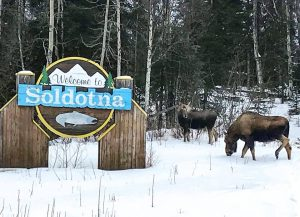
Soldotna -
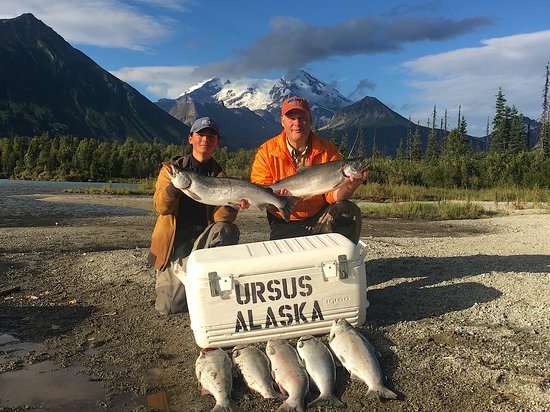
Soldotna is our primary home base for our fishing tours and for good reason. It’s a well-run city with some of the best salmon and trout fishing in the world. If you enjoy catching and eating salmon then this is the place you’ll want to do some whackin, stackin and vacuum packin! It is also close to great saltwater surf or boat fishing in Cook Inlet. Another advantage is close driving proximity to Kasilof, Ninilchik, Homer, Kenai, Sterling and Seward in case that’s where the hot fishing is or other interests you may have.
Interesting History
Soldotna is located in the Southcentral portion of Alaska on the central-western portion of the Kenai Peninsula. The city limits span 7 square miles along the Kenai River, which empties into the Cook Inlet in the nearby city of Kenai. Soldotna is located on the western edge of the vast Kenai National Wildlife Refuge, a protected area spanning nearly 2 million acres and home to bears, moose, caribou, sheep, and many fish and bird species.
The city is located at the junction of the Sterling Highway and the Kenai Spur Highway, which has enabled Soldotna to develop as a service and retail hub for the Central Peninsula as well as for travelers between Anchorage and Homer. The Central Peninsula Hospital serves the medical needs of the region’s residents and tourists. The Kenai Peninsula College, a branch of the University of Alaska Anchorage, operates the Kenai River Campus in Soldotna. Additionally, the headquarters of the Kenai National Wildlife Refuge, the Kenai Peninsula Borough, and the Kenai Peninsula Borough School District are located in the city.
In 1947, after World War II, the United States government withdrew a number of townships along Cook Inlet and the lower Kenai River from the Kenai National Moose Range, opening up the area to settlement under the Homestead Act. Veterans of the United States armed services were given a 90-day preference over non-veterans in selecting land and filing for property. Also in that year, the Sterling Highway right-of-way was cleared of trees from Cooper Landing to Kenai. The location of present-day Soldotna was selected as the site for the highway’s bridge crossing the Kenai River.
The construction of the Sterling Highway provided a link from the Soldotna area to the outside world. More homesteads were taken and visitors came to fish in the area. The Soldotna Post Office opened in 1949 and other businesses opened in the next few years.
Oil was discovered in the Swanson River region in 1957, bringing new economic development to the area. In 1960, Soldotna was incorporated as a fourth class city with a population of 332 and an area of 7.4 square miles (4,723.4 acres). Then seven years later, in 1967, Soldotna was recognized as a first class city. In 1964, the Kenai Peninsula College, the Kenai Peninsula Borough government, and the Kenai Peninsula Borough School District were formed.
According to the United States Census Bureau, the city has a total area of 7.4 square miles of which 6.9 square miles of it is land and 0.5 square miles of it (6.34%) is water. Soldotna first appeared on the 1960 U.S. Census as an unincorporated village. It formally incorporated in 1967.As of the 2010 US Census, there were 4,163 people residing in 1,720 households in the city. The population density was 563 people per square mile.
The racial makeup of the city was 86 percent White, 0.3 percent Black or African American, 4.3 percent Native American, 1.6 percent Asian, 0.3 percent Pacific Islander, 0.8 percent from other races, and 6.8 percent from two or more races. Hispanic or Latino residents of all races comprised 3.9 percent of the population.
Soldotna is home to the Kenai Peninsula College’s (KPC) Kenai River Campus, a division of the University of Alaska Anchorage. The campus sits among 300 wooded acres on Soldotna’s west side and includes a library, laboratories, computer labs, a residence hall, and an art gallery. The Kenai River Campus enrolls approximately 2,500 students a semester and offers associate’s and bachelor’s degrees, certificate programs, and occupational endorsement certificates.
The Soldotna Visitor’s Center, located at the Kenai River Bridge, includes wildlife displays of brown and black bear, dall sheep, bison, wolverines, bald eagles, mountain goats, king crabs, various birds and the world record king salmon. Located near the Soldotna Visitor’s Center is the Homestead Museum, a collection of early structures including the original Slikok Valley School and examples of homestead cabins. The museum also houses Alaska Native artifacts.